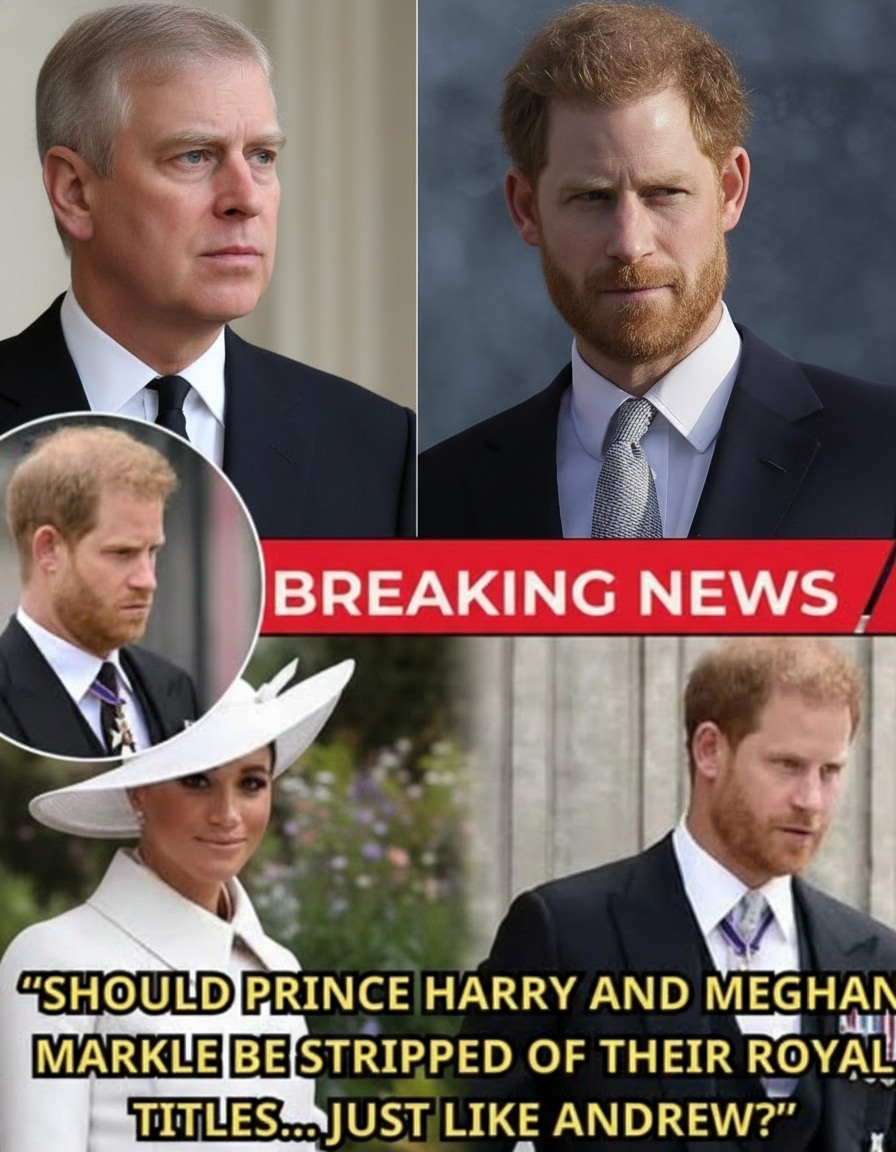

For years, it has lingered at the edges of public debate — whispered rather than declared, avoided rather than addressed. But now, the question is no longer subtle, and no longer avoidable.
Should Prince Harry and Meghan Markle be stripped of their royal titles?
What once seemed unthinkable has become a recurring headline, a growing frustration among traditionalists, and an uncomfortable dilemma for a monarchy already navigating its most fragile era in decades. Comparisons are increasingly drawn to Prince Andrew — once a senior royal, now firmly pushed to the margins of royal life. And with each passing controversy, the Palace’s silence feels heavier.
This is no longer about personal grievances or media drama. It is about identity, duty, and the limits of what it means to be royal in the modern age.
From Royal Exit to Royal Paradox
When Prince Harry and Meghan Markle stepped back from their roles as working royals, the message was framed as a search for independence, privacy, and freedom from institutional constraints. The Palace agreed to a carefully structured arrangement: they would no longer represent the Crown, no longer receive public funding, but would retain their titles.
At the time, it felt like a compromise — imperfect, but workable.
Years later, that compromise appears increasingly strained.
Harry and Meghan have built a public life that frequently intersects with — and at times openly critiques — the institution they no longer serve but still symbolically represent. The result is a paradox: royal titles attached to a narrative often at odds with the monarchy itself.
Why Titles Matter More Than Ever
Royal titles are not merely ceremonial. They carry authority, legitimacy, and historical weight. They imply alignment with the values of the Crown — restraint, service, discretion, and loyalty to the institution above the individual.
Critics argue that Harry and Meghan’s continued use of their titles undermines those principles. Their commercial ventures, high-profile interviews, and public commentary raise an uncomfortable question: can one profit from royal status while rejecting royal responsibility?
Supporters counter that titles are part of Harry’s birthright and Meghan’s lawful marriage into the family — not privileges that can be revoked simply because they chose a different path.
But the monarchy has never been governed solely by legal definitions. It has survived by perception.
And perception is shifting.
The Prince Andrew Comparison
Any discussion of stripping titles inevitably invokes Prince Andrew — a figure whose fall from royal favor was decisive and public. While his titles were not legally removed, his role within the monarchy was effectively erased. He was stripped of military affiliations, patronages, and the right to use “His Royal Highness” in any official capacity.
The comparison is uncomfortable — and deeply controversial.
Prince Andrew’s marginalization followed scandal of the gravest nature. Harry and Meghan’s situation is fundamentally different. There are no criminal allegations, no institutional disgrace of that scale.
Yet the Palace’s actions toward Andrew demonstrated something crucial: the monarchy is willing to redraw boundaries when its survival and credibility are at stake.
That precedent now looms over the Sussex debate.
A Monarchy Under Pressure
King Charles III inherited a monarchy already under strain — generational change, public skepticism, and the challenge of remaining relevant without losing dignity.
Every decision he makes is scrutinized for symbolism. Every silence is interpreted as weakness or calculation.
The continued ambiguity surrounding Harry and Meghan’s status places the King in an impossible position: act decisively and risk deepening family wounds, or do nothing and risk appearing indecisive — or worse, complicit.
The longer the issue remains unresolved, the more it overshadows the institution itself.
Public Sentiment Is No Longer Divided — It Is Fatigued
Perhaps the most telling shift is not anger, but exhaustion.
Public discourse around Harry and Meghan has evolved from shock to sympathy, from sympathy to polarization, and now into fatigue. Many royal watchers express less outrage than weariness — a sense that the drama has become a distraction from the monarchy’s broader role.
For them, the question is not punishment, but clarity.
Are Harry and Meghan insiders, or outsiders?
Representatives, or commentators?
Royals, or celebrities with royal branding?
The lack of a clear answer erodes trust.
What Stripping Titles Would — and Would Not — Mean
Stripping titles would be unprecedented in modern royal history outside of extreme circumstances. It would send a powerful message: that royal identity cannot be selectively adopted or rejected based on convenience.
But it would not erase Harry’s birth, nor Meghan’s place in history. It would not silence criticism, nor end public debate.
In fact, it might intensify it.
There is also the risk of reinforcing the very narrative Harry and Meghan have long advanced — that the institution is punitive, inflexible, and unwilling to evolve.
The Palace must weigh symbolism against consequence.
The Case for Leaving Things As They Are
Some argue that time itself is the solution. That as Harry and Meghan build lives increasingly detached from royal relevance, the issue will resolve naturally — titles fading into formality rather than influence.
This approach favors quiet containment over confrontation — a strategy the monarchy has often employed with mixed success.
But critics warn that inaction is no longer neutral. In the digital age, silence does not preserve dignity; it invites interpretation.
A Question of Fairness — Not Just Authority
There is also the question of consistency.
If one royal can be effectively removed from public life for threatening the institution’s credibility, while others continue to use royal titles while criticizing that same institution, where is the line?
Fairness matters — not only within the family, but in the eyes of the public.
The monarchy’s authority rests on moral coherence as much as tradition.
An Uncomfortable Truth the Palace Must Face
At its core, this debate is not about Harry and Meghan alone. It is about what the monarchy is willing to tolerate in order to preserve unity — and what it risks by avoiding decisive action.
Every institution must eventually define its boundaries. The monarchy is no exception.
And the longer the question remains unanswered, the louder it becomes.
No Easy Ending — Only Consequences
There is no solution that avoids pain. Stripping titles would deepen personal fractures and invite global backlash. Doing nothing risks normalizing a blurred royal identity that undermines the institution’s clarity.
What the Palace faces is not a choice between right and wrong — but between different kinds of damage.
History will judge not only what decision was made, but when.
The Question That Refuses to Fade
“Should Prince Harry and Meghan Markle be stripped of their royal titles?”
It is uncomfortable.
It is divisive.
And it is no longer hypothetical.
The Palace may wish to move on.
But the question is no longer willing to wait.